Threads
OCCT ships no “thread feature” — a screw thread is a composite feature with no single kernel op. OCCTSwift provides one on Shape: threadedShaft (external) and threadedHole (internal), producing real helical ISO-68 / Unified V-form geometry (60° included flank angle, truncated crest and root per the standard).
For the common case — a plain cylinder coaxial with the axis — threadedShaft builds the threaded rod directly, with no boolean (#213): the thread cross-section (a “cam”: root arc → flank → crest arc → flank) is lofted along the helix with ruled=false, giving a smooth, BRepCheck-valid solid of a handful of BSpline faces (not hundreds of facets), with any unthreaded margin closed by sewing. Because the kernel’s boolean is never invoked, the result is orientation-robust where a cut-the-cutter approach is faceted or fails.
OCCT C++ reference: the bottle tutorial — “Building the Threading” (/open-cascade-sas/occt on context7).
A threaded shaft
Cut an M12×1.75 external thread into a Ø12 shank — 18 mm of thread on a 24 mm rod:
guard let shank = Shape.cylinder(radius: 6, height: 24) else { return }
let spec = ThreadSpec(form: .iso68, nominalDiameter: 12, pitch: 1.75)
guard let threaded = shank.threadedShaft(axisOrigin: .zero, axisDirection: SIMD3(0, 0, 1),
                                         spec: spec, length: 18) else { return }
// threaded.isValid == true; ~9 faces (smooth), crest at the nominal radius (6 mm)
threadedShaft — M12×1.75 |
🖱️ Drag to orbit · scroll to zoom · auto-rotating. The static render shows until the 3D model loads. (Model exported straight from the snippet above via Exporter.writeGLTF.)
Measuring the envelope — use the optimal box
The smooth thread is a BSpline solid, so its default axis-aligned bounds is the control-pole hull and overshoots the real surface by ~13% — a pole artifact, not a bulge. For the true extent (the crest sits exactly at the nominal radius), use boundingBoxOptimal():
threaded.bounds.max.x               // ~6.8 — pole hull, misleading
threaded.boundingBoxOptimal()?.max.x // ~6.0 — the real crest radius (= nominal/2)
Specs from a string
ThreadSpec.parse reads the usual designations — metric M…x… and Unified …-… UNC/UNF (with the coarse-pitch table for a bare metric diameter):
ThreadSpec.parse("M5x0.8")     // .iso68,   Ø5,    pitch 0.8
ThreadSpec.parse("M10")        // .iso68,   Ø10,   pitch 1.5  (coarse-pitch table)
ThreadSpec.parse("1/4-20 UNC") // .unified, Ø6.35, pitch 1.27 (25.4/20)
ThreadSpec.parse("3/8-16")     // .unified, Ø9.525, pitch 1.5875
Key derived dimensions (all per ISO-68) are available on the spec:
let m12 = ThreadSpec(form: .iso68, nominalDiameter: 12, pitch: 1.75)
m12.theoreticalDepth   // H  = pitch·√3/2
m12.cutDepth           // 5H/8 — practical truncated depth
m12.minorDiameter      // nominal − 2·cutDepth
m12.halfFlankAngle     // π/6 (30° → 60° included)
Thread forms
ThreadForm covers the common standards — set it on the ThreadSpec:
| Form | ThreadForm | Angle / shape |
|---|---|---|
| Metric M / Unified (UNC, UNF, SAE, metric-fine) | .iso68 / .unified | 60° V (the standard is just a pitch) |
| Whitworth (BSW) / BSP parallel (G) | .whitworth / .bspParallel | 55° |
| ACME / metric trapezoidal (Tr) | .acme / .trapezoidal | 29° / 30° trapezoid (lead screws) |
| Square | .square | 0° walls |
| Buttress (DIN 513) | .buttress | asymmetric 3° / 30° |
| Knuckle / round (DIN 405) | .knuckle | 30° rounded |
| NPT / BSPT (tapered pipe) | .nptTapered / .bsptTapered | 60° / 55° on a 1:16 taper |
// An ACME lead-screw thread.
let acme = ThreadSpec(form: .acme, nominalDiameter: 14, pitch: 3)
let leadScrew = stock.threadedShaft(axisOrigin: .zero, axisDirection: SIMD3(0, 0, 1),
                                    spec: acme, length: 40)
.acme (29°) | .square | .buttress (DIN 513, 3°/30°) |
External threads on a cylinder use the smooth, valid direct build for every form; internal threads (threadedHole) cut a smooth helical cutter into the wall (also valid). Non-cylinder external targets and the tapered pipe forms use a robust faceted cut.
Specs from a designation
ThreadSpec.parse reads the standard designations across forms:
ThreadSpec.parse("Tr40x7")      // .trapezoidal, Ø40, pitch 7  (LH: "Tr40x7LH")
ThreadSpec.parse("1.5-4 ACME")  // .acme,        Ø38.1, pitch 6.35
ThreadSpec.parse("G1/2")        // .bspParallel, Ø20.955, 14 TPI
ThreadSpec.parse("R3/4")        // .bsptTapered  ("Rc…" for the parallel-internal/taper pair)
ThreadSpec.parse("W1/2")        // .whitworth    (also "1/2 BSW")
ThreadSpec.parse("1/2-14 NPT")  // .nptTapered
(Metric M…, Unified …-… UNC/UNF, fractional 3/8-16 still parse as before.)
Threading with a custom shape
Beyond the standard forms, thread a cylinder with any cross-section by supplying a ThreadProfile — a normalized tooth outline over one pitch (axial 0…1 along the pitch, depth 0 at the crest/major radius … 1 at the root/minor radius). It builds via the same smooth direct path.
// An asymmetric sawtooth tooth.
guard let profile = ThreadProfile(vertices: [
    .init(axial: 0.0, depth: 1), .init(axial: 0.1, depth: 1),   // root flat
    .init(axial: 0.5, depth: 0), .init(axial: 0.6, depth: 0),   // up to a crest flat
    .init(axial: 0.9, depth: 1), .init(axial: 1.0, depth: 1),   // back down to root
]) else { return }
let spec = ThreadSpec(customProfile: profile, nominalDiameter: 12, pitch: 2, cutDepth: 1)
let custom = stock.threadedShaft(axisOrigin: .zero, axisDirection: SIMD3(0, 0, 1),
                                 spec: spec, length: 16)
ThreadProfile validates the outline (periodic, spans a crest and a root) and is Codable, so a custom form round-trips through JSON.
A threaded hole
threadedHole taps the wall of an existing bore. It’s cut with the boolean path — but because an interior helix is cut into a thick wall (not a thin shaft), OCCT’s boolean handles a smooth helical cutter robustly, so the internal thread comes out smooth and BRepCheck-valid. Pass the solid with the bore already in it:
guard let outer = Shape.cylinder(radius: 12, height: 16),
      let bore  = Shape.cylinder(radius: 6,  height: 16),
      let block = outer.subtracting(bore) else { return }   // an annulus
let tapped = block.threadedHole(axisOrigin: .zero, axisDirection: SIMD3(0, 0, 1),
                                spec: ThreadSpec(form: .iso68, nominalDiameter: 12, pitch: 1.75),
                                depth: 14)
// tapped?.isValid == true; tapping only adds material toward the axis (outer Ø unchanged)
Because the body is just any solid with a bore, you can tap nuts of any shape — a hex prism (extruded hexagon), a wing nut (body + wings), or a lead-screw nut. The pieces below are built from the snippets on this page (Wire.polygon → Shape.extrude for the hex, union for the wings, .square thread for the lead screw, and a pipeShell coil — see Helices & Springs — for the anti-backlash spring):
ISO M12 hex nut | 3/8-16 UNC wing nut | 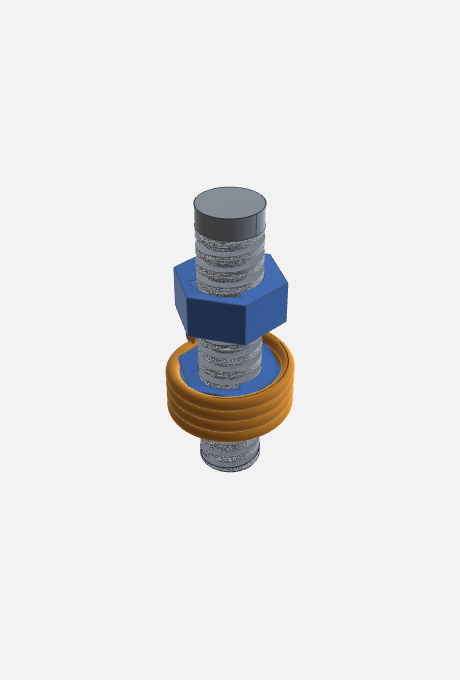 Square lead screw + anti-backlash nut & spring |
🖱️ The nut and wing nut are interactive (drag to orbit). The lead-screw assembly — a square-thread screw, a hex half-nut, and a compression spring that pushes the split nut apart to take up backlash — is a static render of a 4-part assembly.
Multi-start and handedness
starts interleaves N thread starts (lead screws, fast-advance fasteners); leftHanded flips the helix. Multi-start and left-handed threads use the boolean cut path:
let leadScrew = ThreadSpec(form: .iso68, nominalDiameter: 16, pitch: 2, leftHanded: true)
let shaft = rod.threadedShaft(axisOrigin: .zero, axisDirection: SIMD3(0, 0, 1),
                              spec: leadScrew, length: 40, starts: 2)
Runout
How the thread terminates where it meets the unthreaded shank:
// .none (default) — hard stop; .filleted — blend the last turns; .tapered — fade depth to zero.
rod.threadedShaft(axisOrigin: .zero, axisDirection: SIMD3(0, 0, 1), spec: spec,
                  length: 18, runout: .filleted(radius: 0.4))
See also
- API mapping:
../../API_REFERENCE.md - Concepts (B-Rep topology, handles):
occt-concepts.md - Why smooth threads can’t be booleaned, and how the direct build works: CHANGELOG v1.5.3.